The presentation continues the Institute’s efforts to increase education of the life-saving technology.
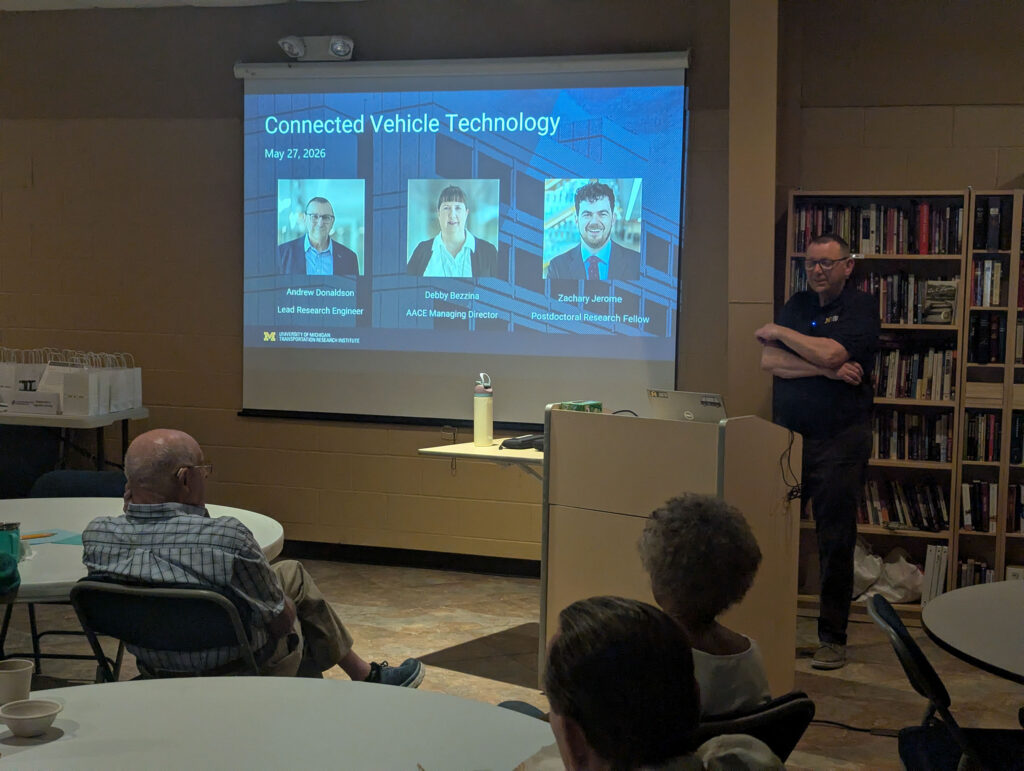
In May, researchers from the University of Michigan Transportation Research Institute (UMTRI) visited Elderwise Learning — a nonprofit, member-driven lifelong learning organization based in Ann Arbor — to share how connected vehicle technology is reshaping transportation safety and efficiency. The presentation, led by Lead Research Engineer Andrew Donaldson, AACE Managing Director Debby Bezzina, and Postdoctoral Research Fellow Zachary Jerome, introduced the audience to Vehicle-to-Everything (V2X) communication: a technology that allows cars, buses, traffic signals, and even pedestrians to share real-time data with one another. Unlike traditional sensors that require a direct line of sight, V2X uses a single radio to receive information from all directions, enabling vehicles to “see through” obstacles and receive warnings about hazards like red light violations, queue backups, emergency vehicles, and vulnerable road users.
The presenters walked the audience through UMTRI’s work on the Ann Arbor Connected Environment (AACE), a project with roots in the 2012 Safety Pilot Model Deployment program, the world’s first large-scale real-world connected vehicle deployment. Today, that infrastructure has grown through the Smart Intersections Project (SIP), which equipped 21 Ann Arbor intersections with C-V2X roadside units and vision perception systems, and outfitted three separate bus fleets with onboard units to enable transit signal priority. The current AACE 2.0 phase is expanding that C-V2X footprint to 75 locations, deploying emergency vehicle preemption on fire trucks, and building a cloud-based open data repository for research and analysis.
Zachary Jerome rounded out the presentation with a deep dive into how connected vehicle trajectory data can be used to retime traffic signals without the costly roadside sensors or traffic engineers traditionally required. By aggregating vehicle trajectory data, comprising roughly 5% of road users, his team developed tools to identify poor signal coordination, measure control delay, and generate optimized timing plans. Working with the Road Commission for Oakland County under a U.S. DOT Strengthening Mobility and Revolutionizing Transportation (SMART) grant, the system has already been applied to 40 intersections across the county, leading to an average 30% reduction in intersection delay and a 40% reduction in vehicle stops.
The talk highlighted how Ann Arbor is serving as a national model for connected vehicle deployment and data-driven traffic management, with UMTRI’s work pointing toward a future where real-time vehicle data drives how our streets are managed. Jerome noted that the research has reached a stage of commercialization, with a startup company called Connected Traffic Intelligence now being launched to help bring the technology to broader deployment.
This story was written by Calvin Tuttle of the Center for Connected and Automated Transportation (CCAT).